

Table of Contents
A school board race is decided by 300 votes. To win it, you need to move roughly 150 net voters to your side. You have 10 days, 15 volunteers, and a $200 budget. Running a gotv small campaign at this scale is not about doing less of what large campaigns do. It is about doing something structurally different.
Most GOTV guides are written for campaigns with a paid field director, a full CRM subscription, and 80 volunteers ready to fan out across a city. Those campaigns exist. But they are not the majority. City council races, school board elections, water district contests, and county commissioner campaigns operate on a completely different scale. The playbook written for a statewide race will waste your volunteers’ hours and demoralize them when they can’t hit the contact targets it assumes.
This guide is built for the math of a small race. It gives you a universe-building framework, a channel stack prioritized by what actually lifts turnout per volunteer hour, and a free tool stack you can use starting today. If you are also working through your broader strategy before GOTV, the local political campaign strategies guide covers the full campaign cycle from voter ID through election day. For the full phase-by-phase GOTV system this guide scales down, see the complete GOTV guide.
What makes GOTV different for a small campaign
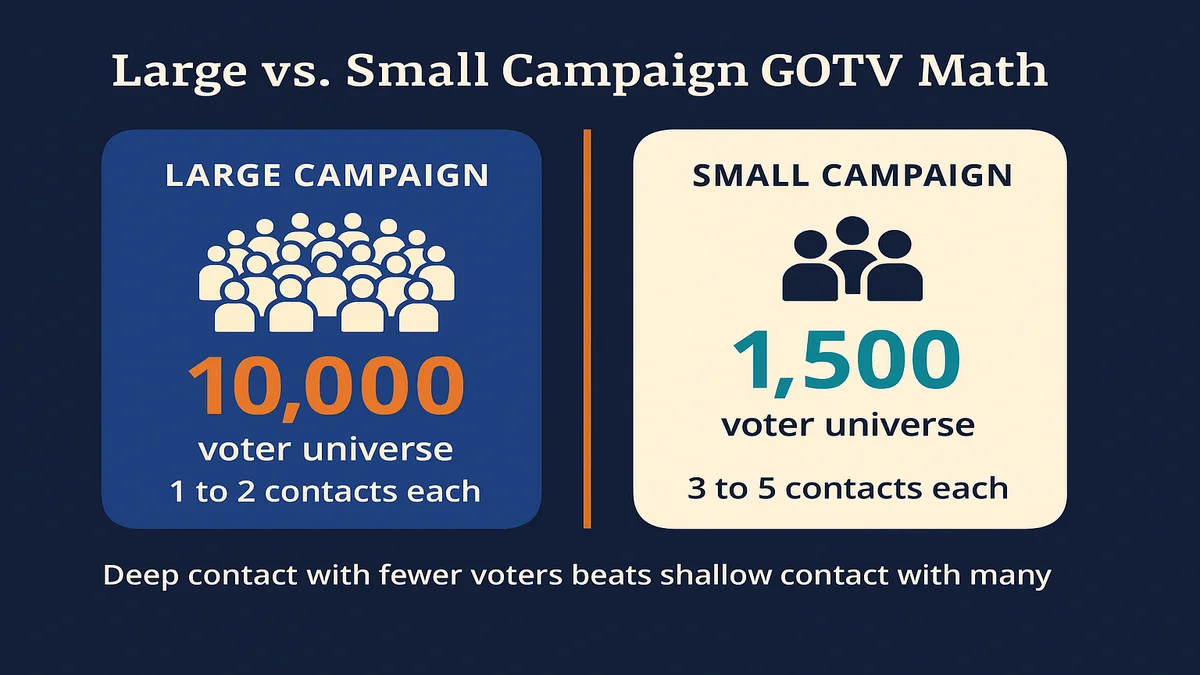
Large campaigns run GOTV like a manufacturing operation: high volume, distributed teams, and software that routes contacts to the right volunteers at the right time. Small campaigns run on completely different constraints. Understanding those constraints is the starting point for building a program that works.
The small campaign math: Races won by margins of a few hundred votes
Consider a local school board race in a midsize county. Turnout is typically 8–15% of registered voters. In a district with 20,000 registered voters, roughly 2,000 people decide the outcome. A candidate who needs to flip 200 net votes has a workable target: identify likely supporters, contact them three to five times before election day, and make sure they vote. See what is voter turnout for how that baseline percentage is calculated and what’s typical for races like yours.
What makes this workable is precision. You are not trying to reach everyone. You are trying to reach your universe and no one else.
Large campaigns run the same logic at 10,000 contacts. The difference is not the strategy. It is the scale. Small campaigns have a structural advantage: their universe is small enough to contact deeply, not just broadly.
Why large-campaign tactics waste limited volunteer hours
Standard GOTV playbooks typically call for:
- A multi-week door knocking program covering the full voter file
- Parallel phone banking shifts with 20–30 volunteers per shift
- Peer-to-peer texting (P2P texting) to tens of thousands of contacts
- Multiple mail pieces running alongside field contact
For a campaign with 15 volunteers and two weeks of runway, running all of these simultaneously is not ambitious. It is a resource scatter that produces shallow contact with a large universe instead of deep contact with a targeted one. Deep contact with 500 voters beats shallow contact with 5,000 in every race decided by a few hundred votes.
Build your universe and keep it small on purpose
The most common GOTV mistake on small campaigns is targeting too broadly. Your voter file probably has 20,000 names in it. Your GOTV universe should have 500 to 2,000.
How many voters do you actually need to contact
Start with your win number. For most local races, that is 50% of expected turnout plus one. Then work backward.
If you expect 2,000 votes total and need 1,001 to win, you already know how many supporters you need to turn out. Subtract the ones you are confident will vote regardless, and the remainder is your GOTV target. That number is almost always smaller than candidates expect.
Research from Yale GOTV experiments shows GOTV contact impact tops out at roughly five touches per voter. Contacting someone six times does not move them more than contacting them five times does. So your universe is not “everyone who might vote for you.” It is “everyone who might vote for you, contacted five times in ten days.”
The four voter tiers: Who to contact, who to skip
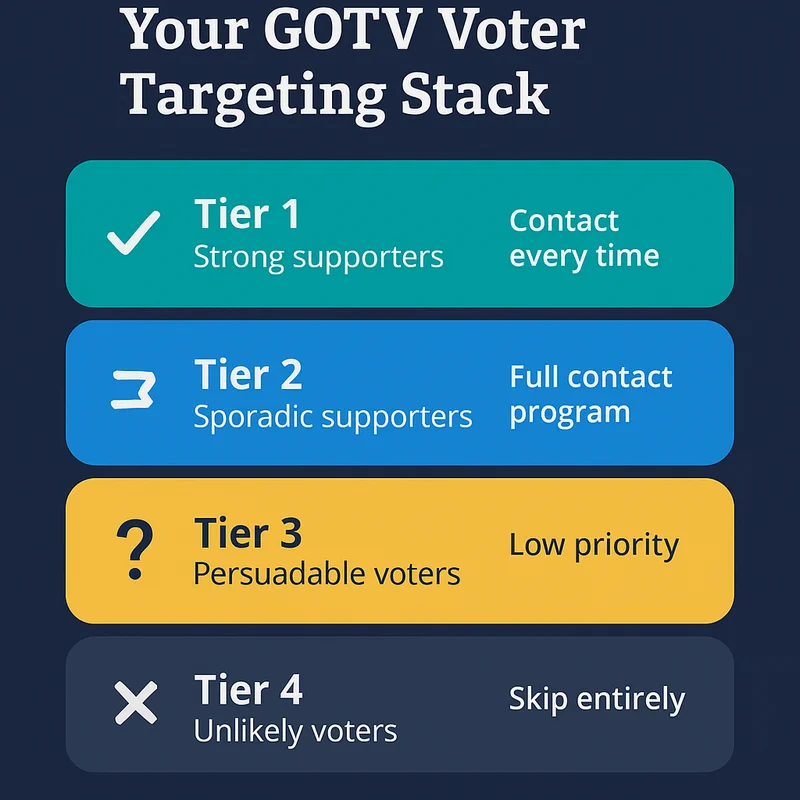
| Tier | Definition | Action | Best channel |
|---|---|---|---|
| Tier 1: Strong supporters | Voted 4+ of last 4 cycles, committed to your candidate | Confirm voting plan, remind day before | Text or personal call |
| Tier 2: Sporadic supporters | Voted 2–3 of last 4 cycles, leaning your way | Full GOTV contact program | Door + phone |
| Tier 3: Persuadable | No clear lean, occasional voter | Low priority, contact only if bandwidth allows | Phone or text |
| Tier 4: Unlikely voters | Rarely votes, no support data | Skip entirely | None |
In most small races, Tier 1 and Tier 2 combined are 500–1,500 voters. That is your universe. Put everything into those two tiers.
Can you run GOTV without a voter file?
You can run a partial GOTV program without a voter file, using endorser lists, neighborhood networks, and volunteer contacts. A full program requires voter registration and history data to identify likely supporters.
Most states and local parties provide this at no cost. If your state provides free access to VAN (Voter Activation Network) for affiliated candidates and committees, that is your first stop. Check with your state party or local county committee.
If VAN access is not available, your county clerk can provide the voter file for free or at low cost. This gives you names, addresses, party registration, and voting history. From that data, you can build a working targeting spreadsheet without a paid CRM subscription.
Choose your channels by ROI, not by budget
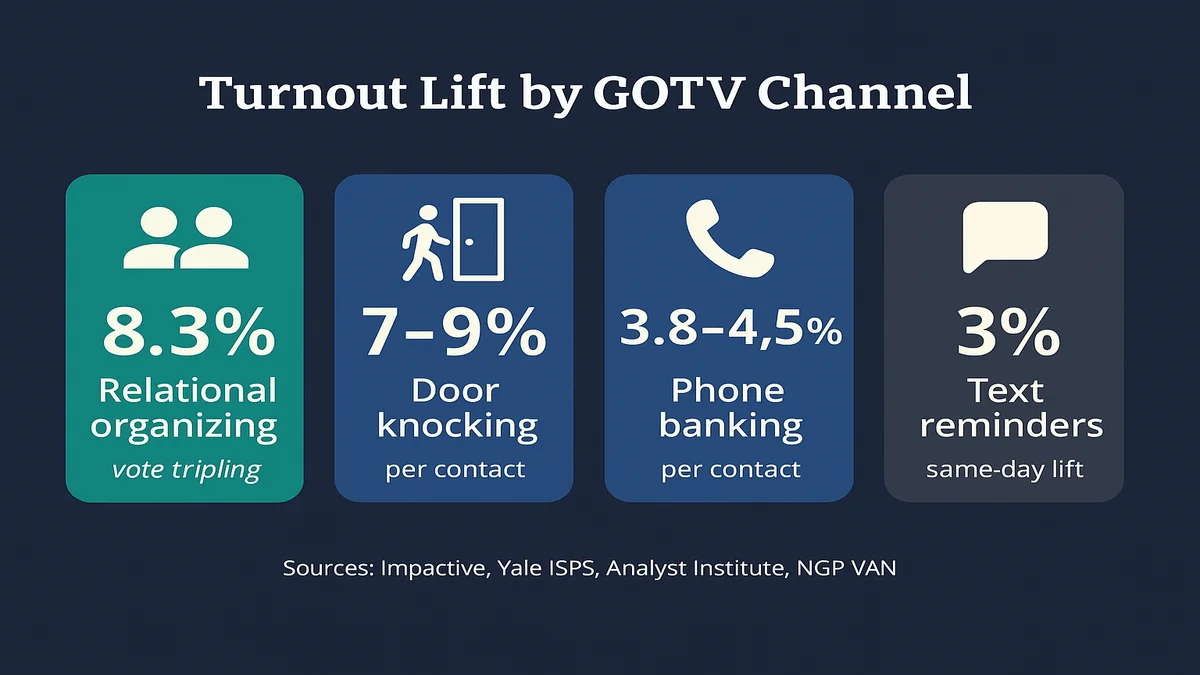
The question to ask is not “what can we afford?” It is “which channel produces the most turnout lift per volunteer hour?” The answer points directly toward your resource allocation.
Relational organizing and vote tripling: The highest-lift zero-cost channel
Relational organizing is the practice of having your volunteers contact people in their own social networks, not strangers from a contact list. Vote tripling is a specific relational organizing technique: each volunteer commits to asking three friends or family members to make a voting plan and follow through.
Research from Impactive found that vote tripling increases turnout by 8.3% in contacted voters. The Analyst Institute estimates relational organizing overall lifts turnout by 6–8 percentage points. These are among the highest per-contact lift numbers in GOTV research.
The structural advantage for small campaigns is this: relational organizing costs nothing and scales through social trust, not money. A well-funded opponent cannot outspend you on it because authentic personal relationships are not for sale. Start here before any other channel. Give every volunteer a list of 10 to 15 people they personally know and a script for a voting plan conversation.
Door knocking: 7–9 points of lift, 15–20 doors per hour
Door-to-door canvassing consistently produces the highest turnout lift of any impersonal contact method. Yale GOTV experiments and Analyst Institute data both put the contact effect at 7–9 percentage points per contacted voter.
The math for a small campaign: One canvasser knocking 15–20 doors per three-hour shift contacts roughly 8–10 people who are home. Over a 10-day GOTV window with two canvassing days per week, two volunteers cover 160–200 meaningful contacts. That is a real number in a 1,500-person universe.
Use door knocking for your Tier 2 voters: Sporadic supporters who need a personal touch to motivate them. Assign walklists geographically so each volunteer covers a compact area. The canvassing script should be short: Are you planning to vote? When? How will you get there?
Phone banking: 3–4 points of lift, 100+ contacts per hour
Volunteer phone banking lifts turnout by 3.8–4.5 percentage points per contacted voter, according to Yale GOTV experiment data and CallHub’s research on over 2 million political calls. The lower lift per contact compared to canvassing is offset by a much higher contact rate: a phone banking session reaches 100+ contacts per hour versus 15–20 doors per hour.
For a small campaign, phone banking is the right channel for your Tier 1 voters: Strong supporters who mostly need a reminder and a nudge on voting logistics. It is also your backup channel for Tier 2 voters you cannot reach by door.
Run phone banking from a single session with three to five volunteers. A three-hour shift with four volunteers can reach 400–600 contacts. For a full breakdown of phone banking for GOTV voter turnout, the key metric is not calls placed but conversations completed.
Texts: Plan-making reminders, not conversation starters
Text outreach as a GOTV tactic lifts same-day turnout by approximately 3%, according to NGP VAN’s research. That is a real effect, but it is the lowest of the three contact channels. Use it accordingly.
Texts work best the day before the election and on election morning: short messages confirming polling location, hours, and a voting plan question. They are not a substitute for phone or door contact. Do not allocate volunteer time to a two-week text program at the expense of phone banking and canvassing.
GOTV texting strategies work best as a closing message to your confirmed supporter list on the final two days, not as the primary contact channel throughout your program. For ready-to-use scripts, see the GOTV text message templates guide.
Free and low-cost tools for small campaigns
You do not need a $500-per-month CRM to run effective GOTV. Here is what a free-first tool stack looks like for a 1,500-person universe.
Voter data and targeting (free options)
- State VAN access: Most state parties and county parties provide VAN access to affiliated candidates. If you are running as a Democrat or Republican, ask your county party committee before paying for anything else.
- County voter file: Your county clerk provides voter registration data for free or at minimal cost. This includes names, addresses, party registration, and voting history, which is enough to build a targeting spreadsheet.
- Open voter file tools: Several states make voter registration data available through open records portals. Search “[your state] voter registration data public records” to find what is available in your jurisdiction.
Canvassing and contact tracking (free or near-free)
- Google Sheets: A shared spreadsheet with volunteer assignments, contact status, and voter notes is sufficient for a 1,500-person universe. Free, accessible from any device.
- Printable walklists: Export your universe to a spreadsheet, sort by address, and print walklists per volunteer per shift. Low-tech and effective.
- MiniVAN free tier: NGP VAN’s canvassing app routes walklists to volunteer phones and syncs results. Check ngpvan.com for current availability and terms for small campaigns.
- Open-source canvassing tools: Several free browser-based canvassing tools exist for campaigns that cannot access VAN. Ask your state party or local organizing networks for current options.
Phone and text outreach (free tier options)
- CallHub free trial: Gives a small campaign access to phone banking and text broadcasting capabilities to test volume and output before committing. Volunteers can participate from any location, no physical setup required.
- OpenVPB: Open Virtual Phone Bank is a free browser-based phone banking tool. No software installation required. Needs a contact list and a script.
- Google Voice (manual fallback): For very small programs with two to three volunteers, Google Voice allows calls from a consistent number at no cost. Manual logging is required.
How to run your final 72 hours on a small campaign
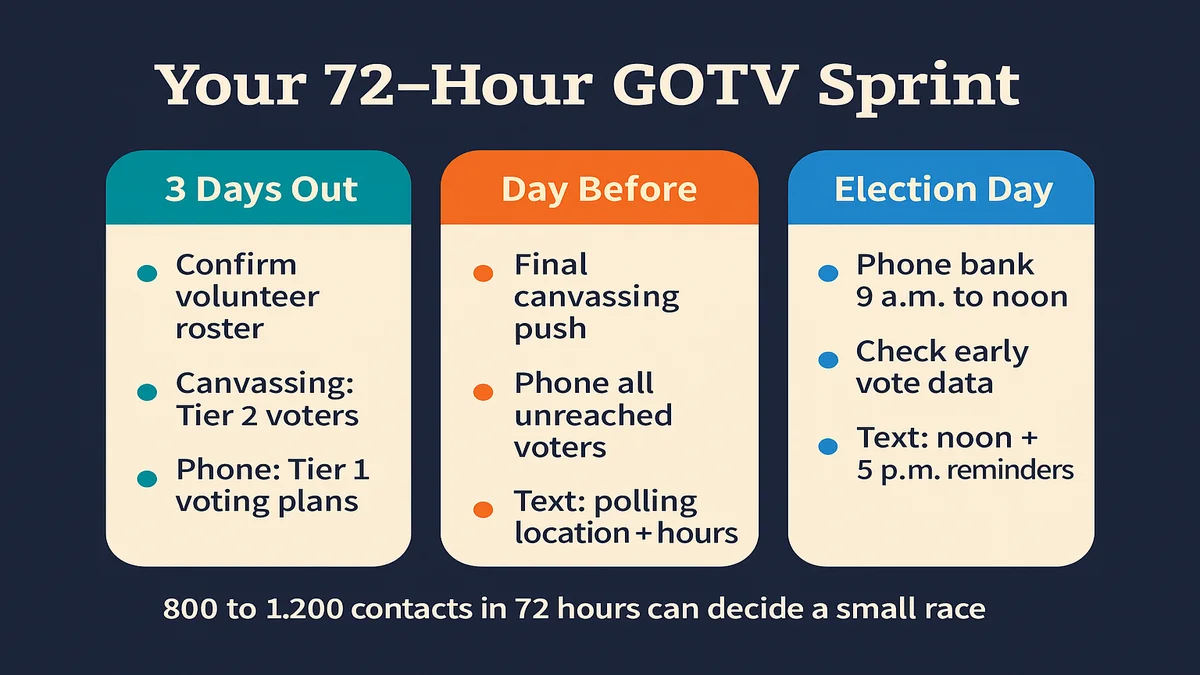
The 72-hour window before polls close is when GOTV contact produces the highest lift. This is your execution phase. For the full-scale version of this calendar, see the GOTV timeline guide.
Three days out:
- Confirm your final volunteer roster and shift assignments
- Run a canvassing shift covering all Tier 2 voters not yet contacted
- Complete a phone banking shift targeting all Tier 1 voters with a voting plan question
- Send your relational organizing volunteers their final vote tripling message and confirm they have reached their three contacts
Two days out (day before election):
- Final canvassing push: Cover any Tier 2 voters still unreached
- Phone bank all Tier 1 and Tier 2 voters who did not pick up earlier in the program
- Send a short text to your full confirmed supporter list with polling location and hours: “Tomorrow is election day. You’re on our list. Can you confirm you’re voting?”
Election day:
- Start a final phone banking shift at 9 a.m., focused on confirmed supporters who have not yet voted
- If your state VAN shows early vote data, filter your call list to remove voters already confirmed as voted
- Assign one to two volunteers as poll monitors at your highest-turnout precincts if your state allows it
- Send a final reminder text at noon and at 5 p.m. to anyone not yet confirmed as voted
A small campaign with 10 active volunteers executing this schedule will make 800–1,200 contacts in the final 72 hours. In a race decided by 300 votes, that contact volume is decisive.
What to cut if you’re starting with five days left
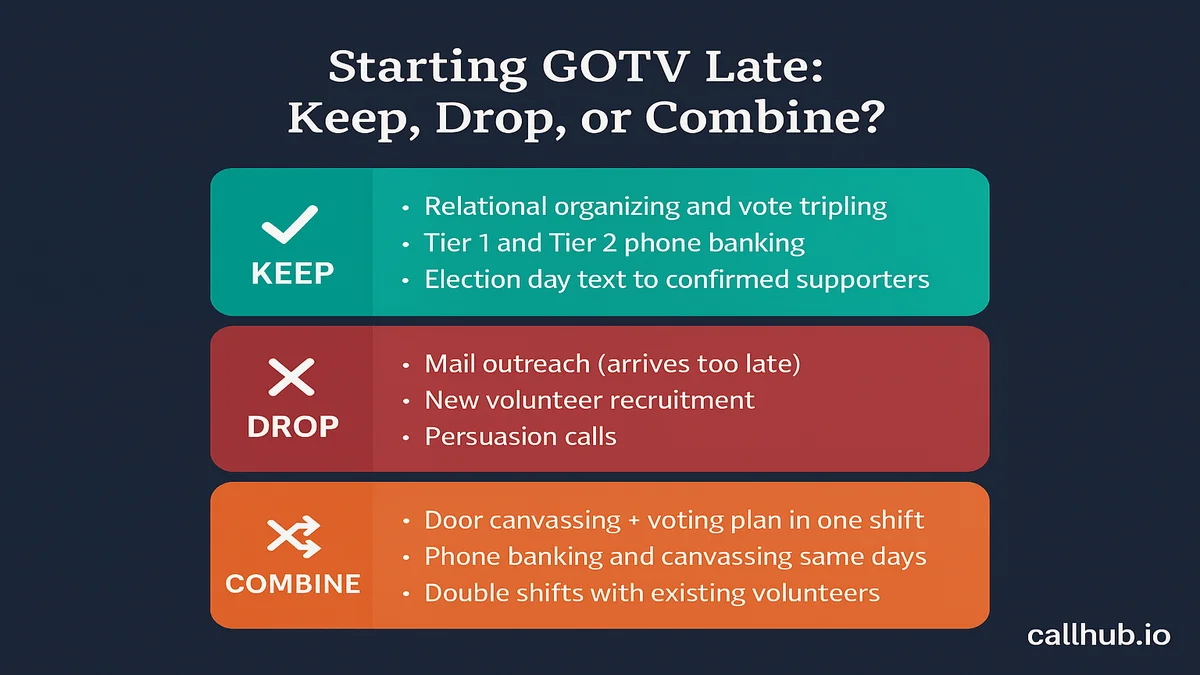
Starting GOTV late is not ideal, but five days is enough to move the outcome in a small race. The key is triage.
| What to keep | What to drop | What to combine |
|---|---|---|
| Relational organizing (vote tripling) | Mail outreach (arrives too late) | Door + voting plan conversation into one script |
| Tier 1 and Tier 2 phone banking | Broad canvassing of low-priority voters | Phone banking and canvassing on the same days |
| Election day text to confirmed supporters | New volunteer recruitment | Use existing volunteers for double shifts instead |
| Door knocking for unreached Tier 2 | Persuasion calls | Move all bandwidth to GOTV contact only |
With five days left, cut anything requiring setup time or producing uncertain return. Spend every volunteer hour on direct contact with your highest-value universe. Get to three to five touches per Tier 1 and Tier 2 voter in the time you have.
For additional last-minute GOTV tips for voter turnout focused on final-week execution, the CallHub resource covers rapid-deployment tactics for campaigns short on time.
How CallHub helps small campaigns do more with less
Small campaigns often assume that phone banking software and text broadcasting are built for large campaigns with large budgets. They are not. CallHub’s platform gives a small campaign access to the same outreach infrastructure used by statewide races, starting with a free trial.
Here is what that means in practice for a 15-volunteer operation:
- Phone banking at scale: Volunteers dial from any device, from any location. No call center needed. A shift of five volunteers can complete 400–600 meaningful conversations in three hours.
- Text broadcasting: Send voting plan reminders and election day messages to your confirmed supporter list in minutes. Scripts are built once and reused across your full program.
- Contact tracking: Every call outcome, text response, and volunteer session is logged automatically. No manual spreadsheet entry required.
- Volunteer coordination: Manage shift assignments, track individual volunteer output, and brief new volunteers on a script without meeting in person.
For a small campaign running on relational trust and tight bandwidth, the advantage is not the feature count. It is that the platform removes the setup friction that keeps small campaigns from running professional-grade outreach. Visit CallHub’s GOTV platform to see the full toolset built for campaigns running lean.
See how CallHub helps small campaigns get out the vote or read the complete guide to get out the vote for the full strategic framework.
Frequently asked questions
How many volunteers do you need to run GOTV on a small campaign?
A minimum viable GOTV program needs five to seven committed volunteers for a 1,000–1,500 person universe. Ten to 15 volunteers gives you the bandwidth for parallel phone banking and canvassing shifts. The key is commitment: five volunteers who show up for every shift outperform 20 who show up once.
What free tools can I use for GOTV on a small campaign?
The core free stack is: County voter file (free from the clerk’s office), Google Sheets for tracking, OpenVPB or CallHub’s free trial for phone banking, and MiniVAN for canvassing if available in your state. This stack can run a full GOTV program for a 1,500-person universe at zero upfront cost.
Can you run GOTV without a voter file?
You can run a partial program using endorser lists, neighborhood networks, and volunteer contacts. A full GOTV program requires voter registration and history data to identify likely supporters and prioritize your universe. Most states and local parties provide this data free or at low cost, so exhaust those options before building without a file.
How long before election day should GOTV start?
For a small campaign, starting GOTV 10–14 days before election day gives enough time for three to five contacts with your full universe. If you are starting later, prioritize depth over breadth: Five touches with 300 voters beats one touch with 1,500 in a close race.
What is the most cost-effective GOTV tactic for a small campaign?
Relational organizing (vote tripling) is the highest-lift zero-cost channel. Impactive research found an 8.3% turnout increase in contacted voters. Door knocking comes second at 7–9 points of lift per contact, but requires more volunteer hours per contact than phone banking. Phone banking reaches far more voters per volunteer hour at 3.8–4.5 points of lift per contact.
How do nonprofits run GOTV without being partisan?
Nonpartisan GOTV is legal for 501(c)(3) nonprofits, with important limits. You can encourage voting and provide voting information without endorsing a candidate or party. Messages must be strictly nonpartisan: “Vote in the upcoming election” rather than “Vote for Candidate X.” Consult your organization’s legal counsel before running any GOTV program to confirm the scope of permissible activities.
How do you prioritize your voter universe when resources are limited?
Build a four-tier system based on voting history and support data. Tier 1 (strong supporters, high-frequency voters) gets your lightest touch: A reminder and a voting plan confirmation. Tier 2 (sporadic supporters) gets your full contact program: Door, phone, and text. Tiers 3 and 4 get nothing or a single text. Most small campaign universes land at 500–1,500 voters when scoped to Tier 1 and Tier 2 only.